Learning something new about Fungi

Given the abundance of informational resources available to us, it’s easy to learn something new just about every day. Even after decades of reading, studying, listening to others and Googling stuff, there’s still so much more to learn. Of course, it’s human nature to focus on topics based on our personal interests and relevance to our lives. I tend to sponge up whatever I can about our natural world, with fungi and organic gardening at the top of my list. Of course, who can pass up watching YouTube videos of pets doing funny things every once in a while?

My latest mind expanding moment came from Kyle Mondron who spoke to CMS in April about “Unraveling the Mating Biology of a Non-Dikaryan Fungus.” According to Google’s chatbot Gemini “Non-Dikaryan fungi, often referred to as “basal” or early-diverging” fungi, are a diverse, ancient group comprising around 5,000 species across 16+ phyla. Unlike Dikarya (Ascomycota and Basidiomycota), these fungi evolved earlier and include key plant-beneficial groups that, for over 400 million years, played a critical role in the initial colonization of land by plants.”
Kyle focused his mating experiments on Linnemannia elongata (syn. Mortierella elongata), a species complex in the subphylum Mortierellomycotina. While older publications refer to it as Mortierella elongata, it was reclassified as Linnemannia elongata based on DNA analyses in 2020. L. elongata is a soil-inhabiting fungus that acts as an endophyte, colonizing the inner tissues of plant roots, particularly within the cortical cells.

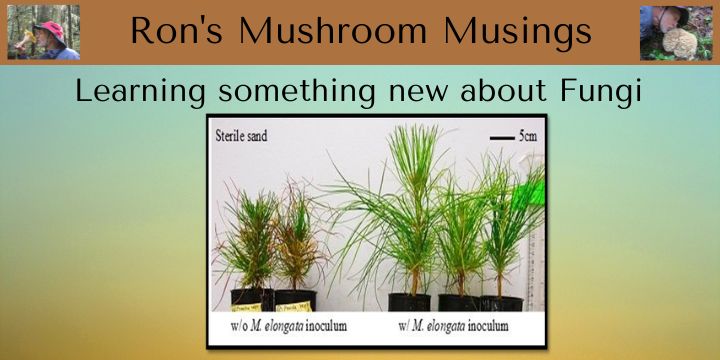
These endophytic fungi exist in a symbiotic relationship where they receive nutrients from the plant while enhancing host growth, nutrient acquisition, and resistance to environmental stress. In the experiment pictured right, taken from an IFAS Extension study, the same substrate was used, but only the sand on the right was inoculated with L. elongata. The research study stated that “The beneficial associations between Mortierella and plants have only recently begun to be understood. M. elongata enhanced the biomass of roots and above ground tissues, enhanced leaf expansion, and increased the amount of chloroplasts in cottonwood, pine, corn, watermelon, tomato, and squash.” Although L. elongata is a very common soil fungus, it is not typically dominant in conventional farming systems that use heavy applications of pesticides, herbicides, and fungicides. It is more abundant in uncontaminated substrates and thrives under organic, healthier soil conditions.
While Kyle’s discussion on the mating rituals of L. elongata was quite interesting and the additional fact that fungi use pheromones to attract compatible mates was fascinating; I was mostly enthralled by L. elongata and its extremely positive relationship with plants. As a long-time advocate of organic gardening, learning about a positive connection between this fungus and plants pleased me to no end. Even though our garden beds are most likely hosting L. elongata, I wanted to try and increase the likelihood that it is abundantly available in our soil.

Kyle had mentioned that crushed crab shells act as a powerful biostimulant for L. elongata by providing a rich source of chitin. Adding chitin fuels the growth and activity of L. elongata, which in turn increases plant root/shoot weight and enhances nutrient uptake (specifically calcium) to boost plant health. If you want to add chitin to your soil, Down to earth sells crab shells in the form of Crab Meal.
If you would like to purchase some, Down to Earth is located at 532 Olive Street. Or, you can do what Sandy and I did and drive to the Oregon coast and pick up lots of upper shell coverings from Dungeness crabs that have molted. During April, May, and June, Dungeness crabs shed their hard, outgrown exoskeleton to grow even larger. These pieces and parts wash up all along Oregon’s beaches. Just fill up a bucket full of crab shells, wash them really good and crush them up before adding them to your soil. In doing so, L. elongata will be fruitful and multiply (Genesis 1:28) and subsequently reward you with healthier plants.
So, if you want more L. elongata,
put some crab in your garden plota!
OK, that was somewhat corny.
Finally, for all you frustrated morel hunters out there, I composed this rap ditty to let you know you’re not alone and I feel your pain.


Sandy and I wish all of you a very fruitful and adventurous summer. The CMS Enews will be back in September.
Ron