Wild Mushrooms in Late Winter

By the time March rolls around, visions of wild mushroom hunting starts turning more toward the arrival of spring mushrooms. While most of our warmer weather mushroom activity happens east of Eugene, the Landscaping Black Morel (Morchella importuna) has been spotted popping up around town as early as March in past years. That should be a good motivator to put down your mobile phone or laptop and start checking out garden patches and renovated landscapes in and around your area. I’m sure some of our more obsessive morel shroomers are already using burn maps and other websites to plot out locations to hunt for burn morels. These species in the genus Morchella have been found as early as May, with greater mushroom flushes occurring in June.

Larger game hunters have their focus set on collecting Eastern Oregon’s Spring Bolete (Boletus rex-veris). While Sandy and I have never found such a large cache of Spring Boletes, Gemini likes to present an optimistic outlook on this year’s fruiting potential. Unfortunately, be aware that several species of fungal gnats are also very fond of Spring Boletes. They also know exactly where to find them without the need of maps or the Web.
It’s always good to check how much damage they may have done before tossing your Boletes into your basket. Finally, there are the spring coral mushrooms that tend to start fruiting a little later in the spring. In a trial-key entitled “Pacific Northwest Spring Ramaria Species” written by Michael Beug, he suggests looking for Ramaria rasilispora, Ramaria coulterae, and Ramaria rubripermanens for edibility. Keep in mind that identifying Ramaria species can be tricky and not everyone responds well to eating them. Always use the tried and true method of just eating a well-cooked spoonful first and waiting 24 hours.

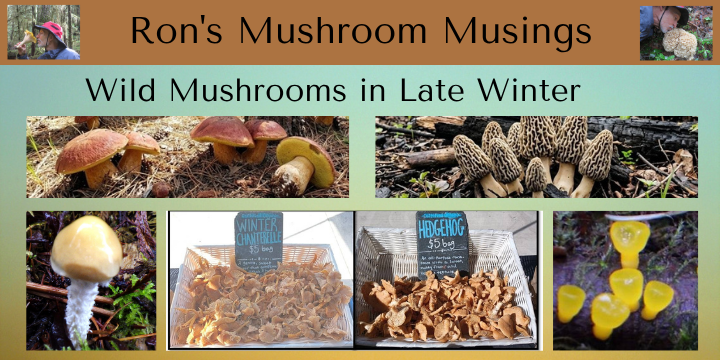
While all this chit chat about spring mushrooms is exciting, some of our winter mushrooms haven’t totally disappeared yet. Sandy and I went to the Lane County Farmer’s Market on March 7th to see what wild mushrooms were still being sold. Dustin, from the Mushroomery in Lebanon, had a basket filled with Yellowfoot and another one filled with Bellybutton Hedgehog mushrooms. Well, that was an interesting discovery. Dustin has always been a great resource for checking out what good edibles are currently fruiting and the general location they might be found.

An even greater surprise was waiting for us just around the corner where Jenny, from Get Fungi in Eugene, had plenty of Yellowfoot and Bellybutton Hedgehog mushrooms, but also a large container of Black Trumpet mushrooms. Are you kidding me? Actually, that was the reaction I had when we saw them. While Sandy and I have rarely found any, we were lucky enough to find some last November while mushroom hunting with Cheshire and Marcia. They are not easy to spot, especially in forests under dim lighting conditions.

Sandy and I had not been mushrooming for quite a few weeks but seeing all these great mushrooms inspired us to get back out there. We decided to drive out Hwy 58 towards Oakridge and check a few of our more familiar spots to see what we could find. The first spots we checked were void of edibles but not of other mushroom species. One of the first mushrooms we encountered was Stropharia ambigua, commonly referred to as the Questionable Stropharia. As this mushroom’s common name is quite peculiar, I searched the Web for clarity and found this explanation; “Stropharia ambigua is called the Questionable or Ambiguous Stropharia primarily because its edibility is highly debated, with many sources considering it potentially poisonous or at least undesirable, while others describe it as edible. Its reputation stems from being hard to identify and sometimes tasting like dirt, making it a “questionable” choice for foragers.” Although I cannot speak to its edibility or flavor, it is an attractive mushroom and fun to find.

Another great find was this very cute and interestingly structured jelly fungus, Dacrymyces capitatus or more commonly referred to as the Yellow Hat Jelly. While quite small, its bright neon-like color makes it extremely visible, even in a dimly lit forest. This cluster was fruiting on a small piece of wood about an inch in diameter and about 5 inches long. It belongs to the Dacrymycetaceae family of fungi which is quite diverse and contains some fairly remarkable looking mushrooms. Many years ago, Marcia Peeters taught me to appreciate the smaller things in the forest and to travel with a hand-held magnifying lens to see their intricate details. As a result, I now travel the woods a little slower and keep a lookout for the tiny dwellers of the mushroom world.

Being so easily distracted by just about every mushroom we found, and there were many, we refocused ourselves on our original mission to find Yellowfoot and/or Bellybutton Hedgehogs. Well, as they would say in France, “Voilà, mission accomplice”. While our journey required some fairly steep uphill climbing to reach the plateau area we were hiking to, it was well worth it. We not only got our steps in and a nice cardio-workout, but we also found Yellowfoot and Bellybutton Hedgehogs still fruiting in the area. Dustin had mentioned to us that he is finding nice patches of edibles n the Cascade Mountains off of Hwy 20 where the snow has recently melted. They may also be fruiting in the Cascade Mountains off of Hwy 126 at similar snow melt elevations.
With a predicted forecast of warm and sunny days ahead, it’s time to take a trip to the woods and reinvigorate the mind and soul and see some cool mushrooms in the process. You might even score some nice edibles.
Ron