Going on a Winter Mushroom Foray
A question someone might ask during this time of year is, “Can I still find mushrooms in January?” Well, I could just say no and make this article an extremely short one; however, that would be fibbing. Besides, my proofreader and article editor Sandy would never let me get away with something like that. Therefore, YES you can still find mushrooms but just realize that Oregon’s primary fruiting season has already come and gone. That said, Sandy and I are still finding a decent amount of mushroom diversity at lower elevations while avoiding the frozen and snow capped higher elevations of the Cascades.
Highly sought after mushroom like chanterelles (Cantharellus formosus) can still be found but their physical condition isn’t always table worthy. On the bright side, edibles like Yellowfoot (Craterellus tubaeformis) and the Bellybutton Hedgehog (Hydnum umbilicatum) thrive during our colder months.
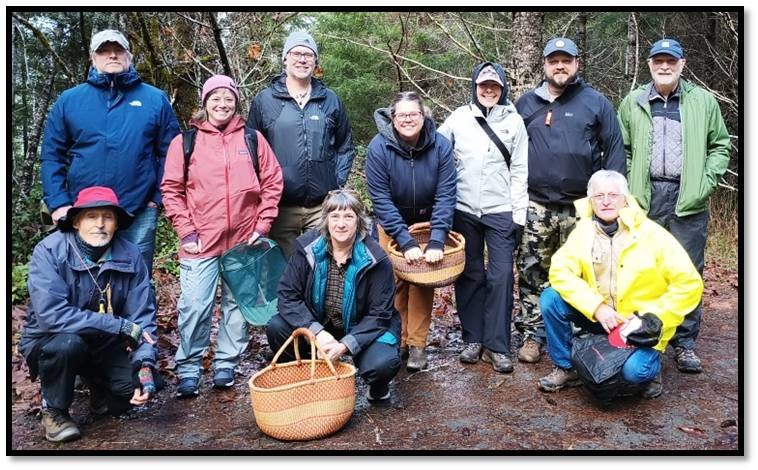
On a recent January CMS foray that Sandy and I led, our very enthusiastic group of participants found a good diversity of mushrooms. We were able to identify more than a dozen mushroom species in addition to finding Yellowfoot and Hedgehogs. While several of our participants did find some chanterelles, only a few of them had not started transitioning from firm to slimy and inedible.
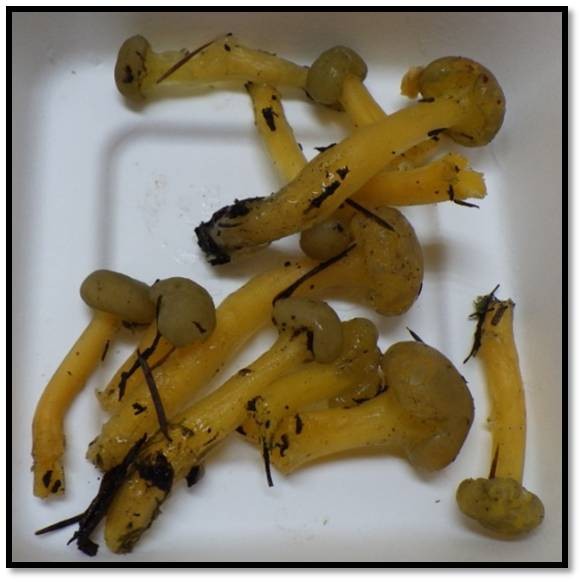
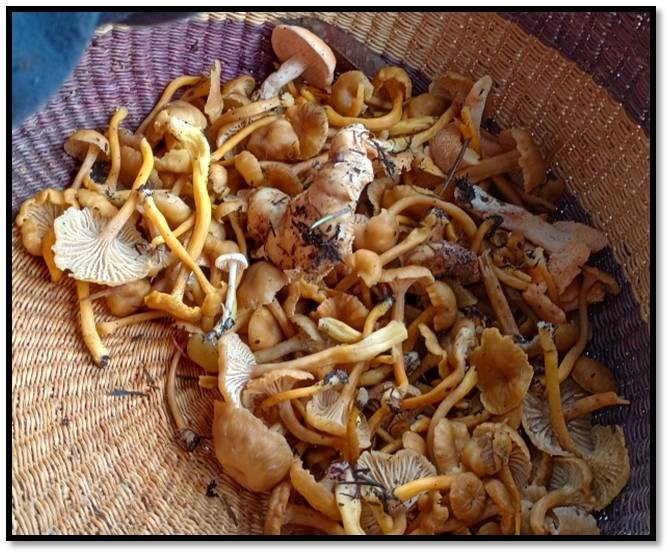
A much more interesting and unusual mushroom that our group found is commonly called the Ochre Jelly Club (Leotia lubrica). Actually, I think this mushroom’s other common name of Jellybaby is more appropriate. Ochre Jelly Club sounds more like some organization that manufactures an ochre colored fruit jelly. While the color of Jellybaby can be quite similar to young Yellowfoot mushrooms, its gelatinous coating and ultra shiny and slimy cap will tell you it’s not.
Unfortunately, we were all so immersed in finding and identifying interesting looking mushrooms that we took very few mushroom pictures in the woods. Sandy did take a picture of some Jellybaby mushrooms that we brought home to identify after putting them into the lid of a compostable takeout container. Since this picture was not taken in the mushroom’s native habitat it does look kind of tacky, but you go with what you’ve got. Compared to other mushroom species, there are not many postings on iNaturalist of Jellybaby sightings in Lane County and quite a few of our fellow CMS members have never seen one in person. Subsequently, I can now say that Sandy and I and our foray participants are among the few but proud members of the “seen a Jellybaby” mushroom society. And, we have a picture, although somewhat corny, to prove it. Besides, if we had taken the picture in its natural setting, someone could accuse us of just having downloaded an image from the Internet.
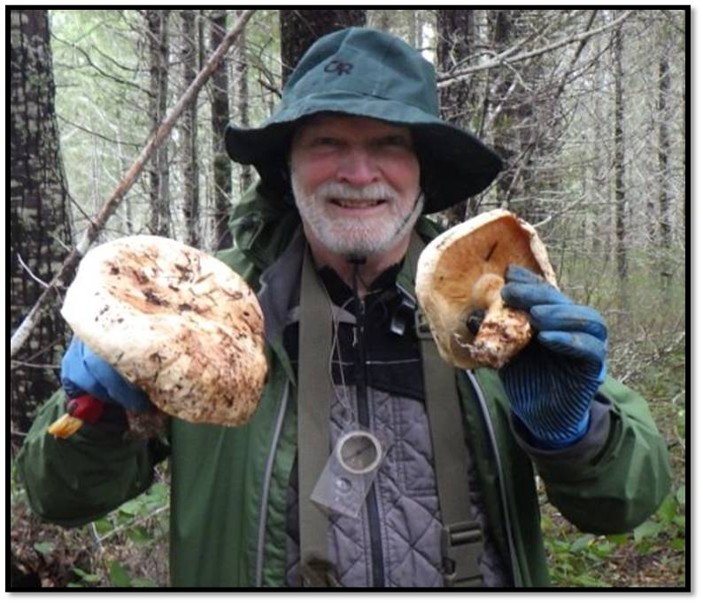
Some of the other mushrooms our group found and identified on our foray included the Waxy Laccaria (Laccaria laccata), Hawk’s Wing (Sarcodon imbricatus), Cat’s Tongue (Pseudohydnum gelatinosum), Manzanita Bolete (Leccinum manzanitae), Bloodred Webcap (Cortinarius sanguineus), Fragrant Funnel (Clitocybe fragrans) and the love it or leave it, dirty socks or Red Hots smelling Matsutake (Tricholoma murrillianum). There were several other interesting mushrooms we encountered on our foray but the late season Matsutake find was our biggest surprise. Here is a picture of Phil with his highly unexpected find. It was just another one of our crowd pleaser mushrooms that everyone enjoyed seeing, identifying and since it was a Matsutake, smelling it. Phil was generous enough to share his find with another member of our group that also enjoys this very popular and highly aromatic mushroom.
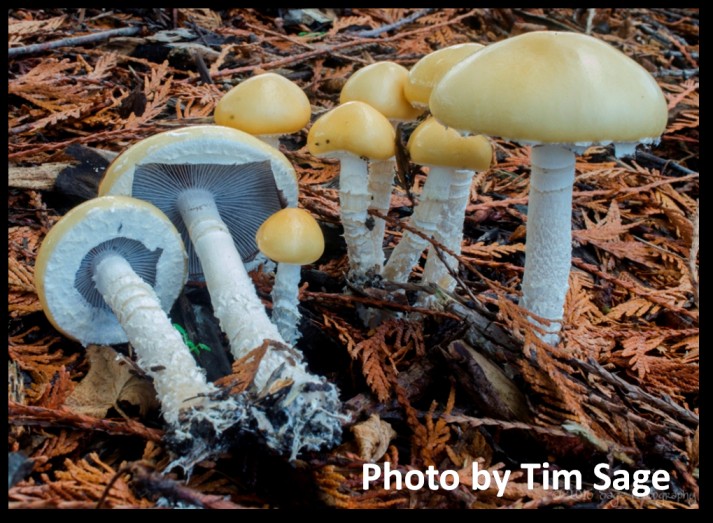
On a final note, we did encounter a “passed its prime” Questionable Stropharia (Stropharia ambigua), who’s edibility I had been curious about for several years. It is a very common mushroom to find and is quite a stately looking one. When Sandy and I started venturing into eating some of the less picked edible mushroom species, this mushroom was on our list. While it is considered to be edible in most mushroom ID books, they don’t seem to give it an overwhelmingly positive endorsement. Recently, I was thumbing through Daniel Winkler’s book, Fruits of the Forest, and came upon his review of this mushroom. Daniel said “It is maligned for tasting like rotten leaves (one of its favorite foods) by some people, while others appreciate its earthy flavor. Most people regard them as marginal, but so are toaster pastries, which are surely worse for your health.” Daniel goes on to say “Tastes best in midwinter – lean times for mushroomers – sautéed in a generous dollop of organic butter. Fair warning: omitting the butter might render this Stropharia inedible.” Well, since Sandy and I have not eaten it yet, I can’t question Daniel’s assessment of this mushroom’s edibility and perhaps that’s why it is commonly called the “Questionable” edible Stropharia. To eat or not to eat, that is the question. If we do try it, I’ll write about it and let you know what we think of it.
Happy mushrooming and if you have the time, check out what winter mushrooms are still fruiting in your favorite foraging areas.
Ron