Hot and Smoky


It’s the 5th of August, and I’ve decided to get a jump on composing my article for September’s newsletter. I could attribute my early start to being an amazingly diligent individual, a stickler for punctuality and fully committed to my newsletter obligations. While that’s mostly true, I started because of being housebound for several days due to Hot and Smoky conditions. Not as a result of various meats smoking away on a hot barbeque while being slathered up with some spicy concoction. The sad reality lies with our very unhealthy air resulting from Oregon’s many wildfires. With ever changing weather patterns and greatly diminished rain and snowpack, forest fires and other weather calamities have become much more common. The impact of which is being felt among all creatures both great and microscopic across the world.
One article I recently read regarding the consequences of these weather calamities began with the statement; “Researchers from Syracuse University and the University of Minnesota find that warming trends will likely result in major disturbances of networks of fungi potentially harming forest resilience.” The article is entitled “How Climate Warming Could Disrupt a Deep-Rooted Relationship.” The researchers where interested in how our warming climate will impact ectomycorrhizal relationships. Using a long term climate change experiment named B4WARMED, they were able to determine how ectomycorrhizal fungi and their tree hosts will respond to increasing environmental stressors. They found that a warming climate resulted in the high mycelial density fungal species normally associated with mature trees being replaced by low density species typically found in highly disturbed ecosystems. This shift in ectomycorrhizal species went from well established complex networks to simpler, less connected ones.
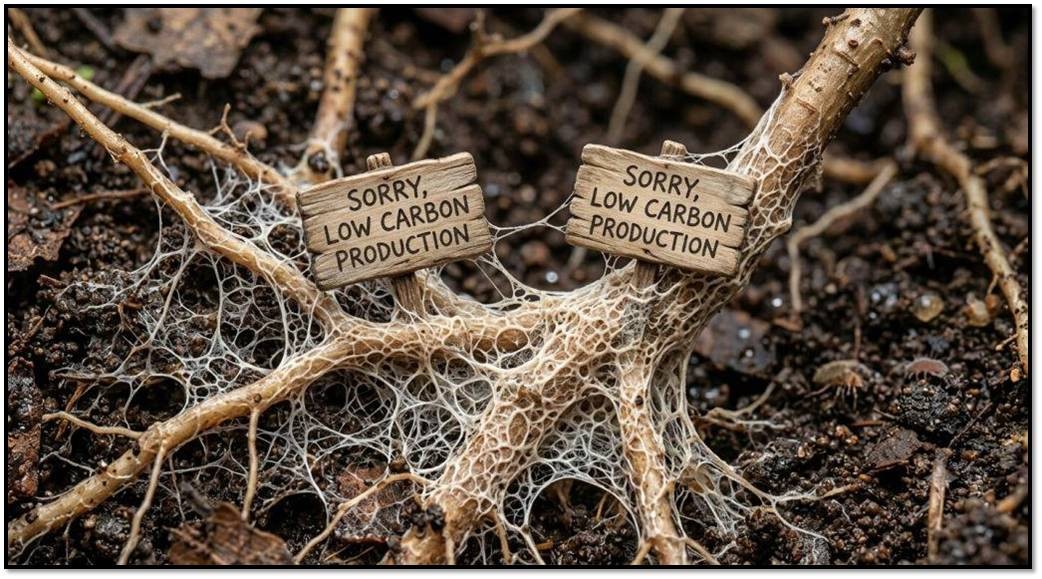
They concluded that “Climate change is reducing the amount of carbon the trees fix and likely has cascading effects on how much carbon they can provide to their ectomycorrhizal fungi.” Basically, the fungal species with high carbon requirements are being starved out. They also stated that “There is a supported hypothesis that these low biomass species probably do not provide the host (trees) much benefit in terms of nutrition compared to high biomass species.” As the researchers originally hypothesized, these ectomycorrhizal transformations can potentially harm overall forest resilience. That’s definitely not an optimistic future for our trees and their fungal partners.

I had originally intended to include a second synopsis of another article I read regarding the “negative” effects of climate change on fungal species. However, I’ve opted to skip including another downer article in favor of some happy mushroom news. While it is true that our changing climate conditions are affecting everything, some local changes were somewhat surprising; maybe even in a slightly positive way?
While Kyle’s discussion on the mating rituals of L. elongata was quite interesting and the additional fact that fungi use pheromones to attract compatible mates was fascinating; I was mostly enthralled by L. elongata and its extremely positive relationship with plants. As a long-time advocate of organic gardening, learning about a positive connection between this fungus and plants pleased me to no end. Even though our garden beds are most likely hosting L. elongata, I wanted to try and increase the likelihood that it is abundantly available in our soil.
In our backyard during early spring, an alder log we brought back from the woods several years ago fruited weeks earlier than previous years. The mushroom was the inedible but attractive Panus conchatus, commonly called lilac oysterling. It has a lilac/purple color when young, decurrent gills and a tough, leathery texture. The mushroom’s common name “oysterling” was no doubt inspired by its physical resemblance to true oyster mushrooms.

The cluster of lilac oysterling in the top left of this composite picture was quite past its prime when this photo was taken. In late July, Sandy and I went hiking at the coast around the Cape Perpetua area where Sandy found a few lobster mushrooms. We typically start looking for these early season mushrooms in mid August but we certainly didn’t reject them for being early.
They were quite firm and absolutely void of fungal gnat larvae, or as the French would more eloquently say, La Larvé. If that wasn’t enough of a surprise, during an early August trip to the coast, Sandy found an Aureoboletus mirabilis, more commonly referred to as the Admirable Bolete. That one was also bug free. The last time we found one of those mushrooms was late last fall in the Cascade Mountain Range. And, to top everything off, Sandy also found a brand new pocket sized case for cleaning glass lenses. At this point you may be wondering what unexpected summer mushrooms or some other thing I might have found. Well, climate change didn’t offer me anything as of yet, but I do take full credit for taking Sandy to the coast with me.
If you haven’t taken any summer hikes into the forests yet, you may want to get out there and see what surprises you might find. Just be wary of our still burning fires and the very unhealthy smoke drifts they create. Safety is always the most important part of any outdoor activity. Don’t forget to thank a tree and you might even give it a little hug as well.
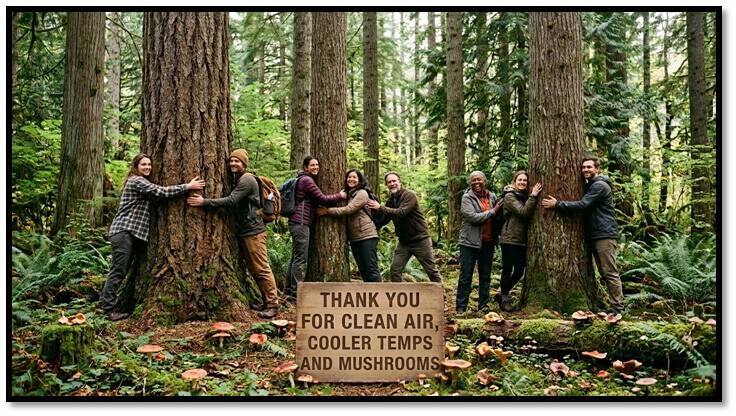
I asked Gemini to create a picture showing some people hugging trees in a forest and this is what it created. I guess the huggers hugging the tree huggers must be backup huggers. Perhaps Gemini wanted to emphasize that hugging is a good thing no matter what or who you hug.
Happy Mushrooming,
Ron