Sutton Campground and Suillus Mushrooms

It’s fairly common for those of us who have foraged for mushrooms for any length of time to create a list of favorite spots to hunt. Some of these spots are fairly well known and often visited by others while more remote spots get put on our special or even secret list. When the late Freeman Rowe would sell his gourds and wild harvested mushrooms at the Lane County Farmers Market, he would talk about his favorite secret hunting spot. It was several miles into the woods and was always filled with chanterelle mushrooms.
Unfortunately, the inevitable happened. One year when we stopped at Freeman’s booth to say hello, he was looking quite annoyed. He told us that someone had found his secret spot and nearly cleaned it out of mushrooms. Sandy and I have often found mushroom remnants left by others when we’ve gone foraging but this was Freeman’s special secret spot. The next year at the Farmers Market, Freeman had a big grin on his face as he told us that “it’s not who knows your secret spot, it’s who gets there first.” Seeing the amount of chanterelles he had collected, we knew exactly who got there first, at least that year. While we were quite delighted at Freeman’s “get their first” success, it made it pretty clear to us that there really are no “secret” spots. They might be less known or less frequented, but certainly not secret. That said, I do think it’s just human nature to avoid revealing our favorite spots. When Sandy and I chat with others, we mostly talk in fairly generic terms regarding where we forage. When asked, we typically tell people to check along the coast, the Lorane Valley or Cascade mountain range. That certainly sounds like reasonable advice to us but to them it’s probably as useless as saying “check around Oregon.” So, to add more clarity to this article, I will be very clear as to exactly where we found our Suillus, as well as other mushrooms.
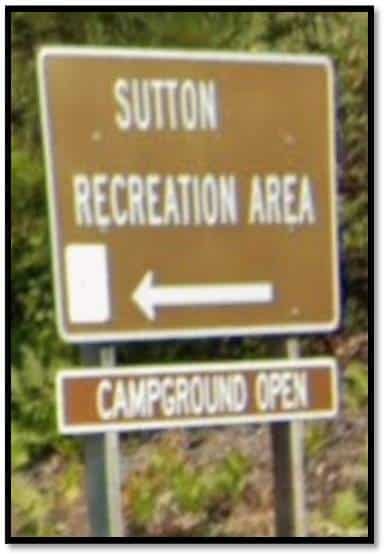
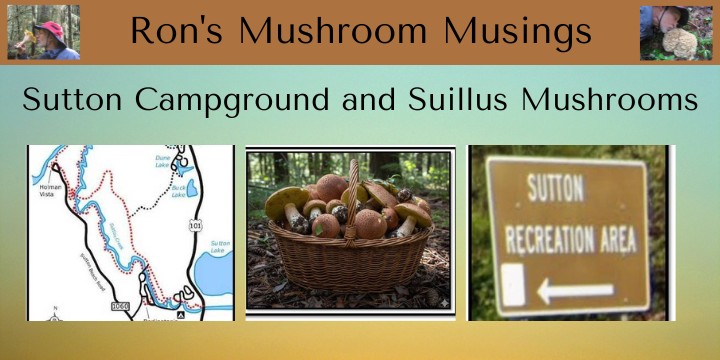
Driving about 5 miles north on US-101 from the intersection of OR-126 & US-101 in Florence, you’ll arrive at the Sutton Recreation Area on your left. This road will take you to the Sutton campground and about 10 miles of easy walking trails. There you will find Douglas fir, spruce and coastal pine trees along with coastal dunes where matsutake mushrooms like to fruit. You can park at the day use area in campground-A and start hiking from there or drive further to another pullout on your right for the Sutton Creek Trailhead. At the end of this road is the Holman day use area with additional trails to try. The mushrooms you’ll find here are quite diverse and can be very plentiful. While we were focusing on finding Suillus species, we also found boletes, lactarius, russula, chanterelles, and Agaricus subrutilescens (the wine-colored Agaricus).
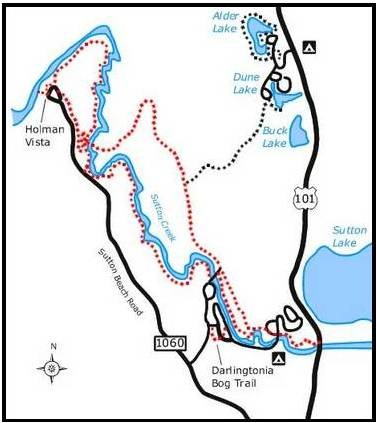
Part of this campground is open year-round but you will need a federal park pass, purchase a day use pass or use the unadvised option of just risking not getting ticketed. The two longest trails are the Sutton Creek South Trail and the Sutton Creek North Trail. The South Trail is more shaded and has a good amount of mushroom diversity while the North Trail will take you through dunes and generally has a more sun exposed environment. If you’re not up for trail hiking, campground-A has plenty of mushrooms along with convenient bathrooms, just in case you need one. It has been our experience that mushrooms love campgrounds, which make them one of our favorite places to forage for them.

As I mentioned earlier, our mission was to find and consume Suillus mushrooms and this location had plenty of them. Unfortunately, this genus of sponge bottom mushrooms has been much maligned in many mushroom books so that many foragers, including us, have totally avoided them. Categorized as slime caps and relegated to being referred to as a subsistence food doesn’t help one’s culinary image. Additionally, the Latin word Suillus translates to “of or pertaining to pigs” or “swinish.” Now tell me, what species of animal looks more swinish and unsophisticated in this picture? Here you have a gathering of very sophisticated Sus domesticus enjoying a typical day of merrymaking. Conversely, Sue and Will are splashing in the mud, either wrestling or doing a bad dance version of the rumba. Subsequently, I would like to propose changing the Latin genus name of Suillus to the much more appropriate English name SueWillus; meaning “of or pertaining to slimy humans”.
To find the Suillus species we were interested in, we started by hiking the North Trail from the Sutton Beach Road entrance. Although we found a nice collection of mushrooms on this trail, the big bonanza of Suillus species were scattered all around campground-A. Our target species was Suillus lakei; not only due to its ease of identification but because it was everywhere.
This species is listed as “Edible” in Noah and Christian’s Mushrooms of Cascadia book and is commonly called the Western Painted Suillus. That’s quite a complimentary nickname as opposed to other Suillus species with names like Slimy Fat Jack or Chicken Fat Slippery Jack. I need to pause here and ask the question, who had a grudge against this genus of mushrooms or did some tortured soul slip on a Suillus and break a leg or something???
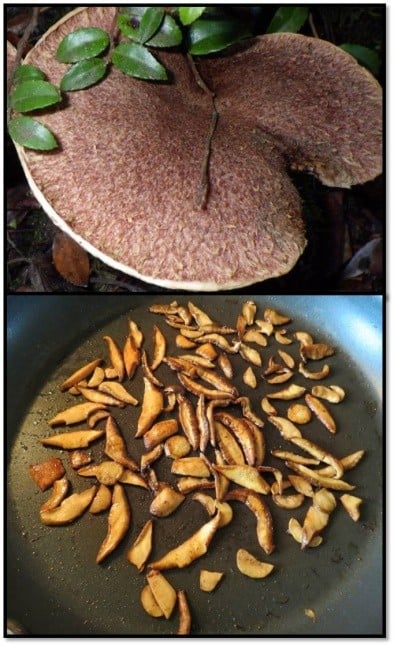
Anyway, the Suillus lakei mushrooms we collected were fairly clean already so only a little touchup cleaning was necessary. However, if you do feel the need to use slow running water to clean your mushrooms, be careful not to wet their sponge bottom as it will soak all that water right up. Some people suggest peeling off the cap’s top layer or cuticle. Since ours were young, firm specimens, there was no need to peel off their cuticle or remove their sponge bottom. We sliced these beauties into thin pieces and sautéed them in butter until they had a nice golden color. You can see by the picture that a pan full quickly reduced down to enough for a snack or side dish. In our opinion, the flavor of this mushroom exceeded the mushroom book’s edibility description of simply being “Edible.” I often wonder if mushroom book authors actually try eating mushrooms before listing an edibility rating or do they just mimic what someone else put in their book. Maybe they should include a disclaimer for each edible species as to having firsthand knowledge or just passing on what someone else wrote about their edibility.
I would have more respect for a book author that actually tried eating their edible listed mushrooms instead of just passing on what someone else wrote. Had I written the first mushroom book, every subsequent book would have mimicked my matsutake (Tricholoma murrillianum) mushroom’s edibility rating of “Edible but not eatable.” And that rating is not due to my not having tried the correct Asian recipe. It is because it tastes like it smells and no amount of soy sauce or tamari can camouflage that flavor. Sorry, that’s just my opinion.
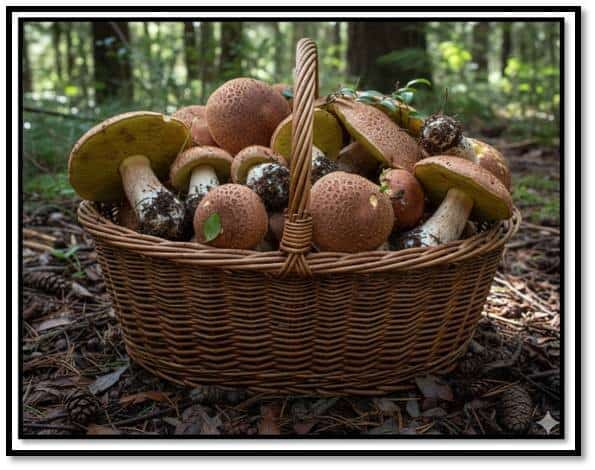
So, in this article I’m not just generically saying to go somewhere on the coast and look around for Suillus or other mushrooms. I’m suggesting you might want to try the trails and campground areas at Sutton Campground. You just might run into some very cheerful members of the “Just Around The Corner” hiking group. Bring a lunch, make a day of it and try some freshly picked Suillus mushrooms. This way you can make your own judgment as to their edibility. Then, send your opinion to your favorite book authors so they can update their books based on popular opinion and not just on what previous books have stated. As always, stay safe and refresh your soul with a nice hike at the coast or your favorite hiking trail.
Bon appétit, Ron